
Why AI Cannot Copy Every Workplace Lesson
AI can summarize a manual in seconds, but it does not automatically know why a veteran engineer ignores one alarm and acts fast on another. It can search a policy, but it does not know which customer relationship needs a careful phone call instead of a standard message.
That is why institutional knowledge AI is becoming a serious management issue in the United States. Companies want faster training, leaner teams, and better internal search. Workers want to know whether their experience still matters.
The honest answer is yes. The smartest use of AI is not to replace experienced people first. It is to help capture, share, and check what they know.
What U.S. Employers Should Understand
- Why AI Cannot Copy Every Workplace Lesson
- The Fast Answer for Teams Using AI
- What Institutional Knowledge Looks Like at Work
- How to Preserve Experience Before It Leaves
- Mistakes That Turn AI Into a Management Problem
- The Bottom Line for U.S. Workplaces
- What to Do This Month
- FAQs
- References
The Fast Answer for Teams Using AI
- Best for: Managers, HR teams, engineers, operations leaders, consultants, and workers evaluating AI tools.
- Main takeaway: AI handles stored information better than lived judgment.
- Effort required: Start with one critical role, 5 structured interviews, and a 30-day review cycle.
- Best result to expect: Better onboarding, fewer repeated errors, and clearer accountability for AI-supported work.
- When not to use this: Do not use AI as the final authority when the decision affects safety, employment, product quality, or customer trust.
What Institutional Knowledge Looks Like at Work
Institutional knowledge is the memory a company builds through people. It includes written files, but the valuable part is often harder to see: how teams handle exceptions, who understands old decisions, which shortcuts are safe, and which shortcuts create future problems.
In a U.S. manufacturing company, that knowledge may live with a maintenance lead who knows which machine failure is urgent. In a software company, it may live with a support manager who remembers why a customer workflow was designed a certain way. In a small business, it may live with the office employee who knows how payroll, vendors, passwords, and customer issues all connect.
Key Terms for This Topic
- Institutional knowledge: Company memory built from systems, people, decisions, and repeated work.
- Tacit knowledge: Experience people use without always being able to explain it quickly.
- Knowledge transfer: The process of moving know-how from one person or team to another.
- AI oversight: Human review of AI outputs before they affect real decisions.
A Realistic U.S. Scenario
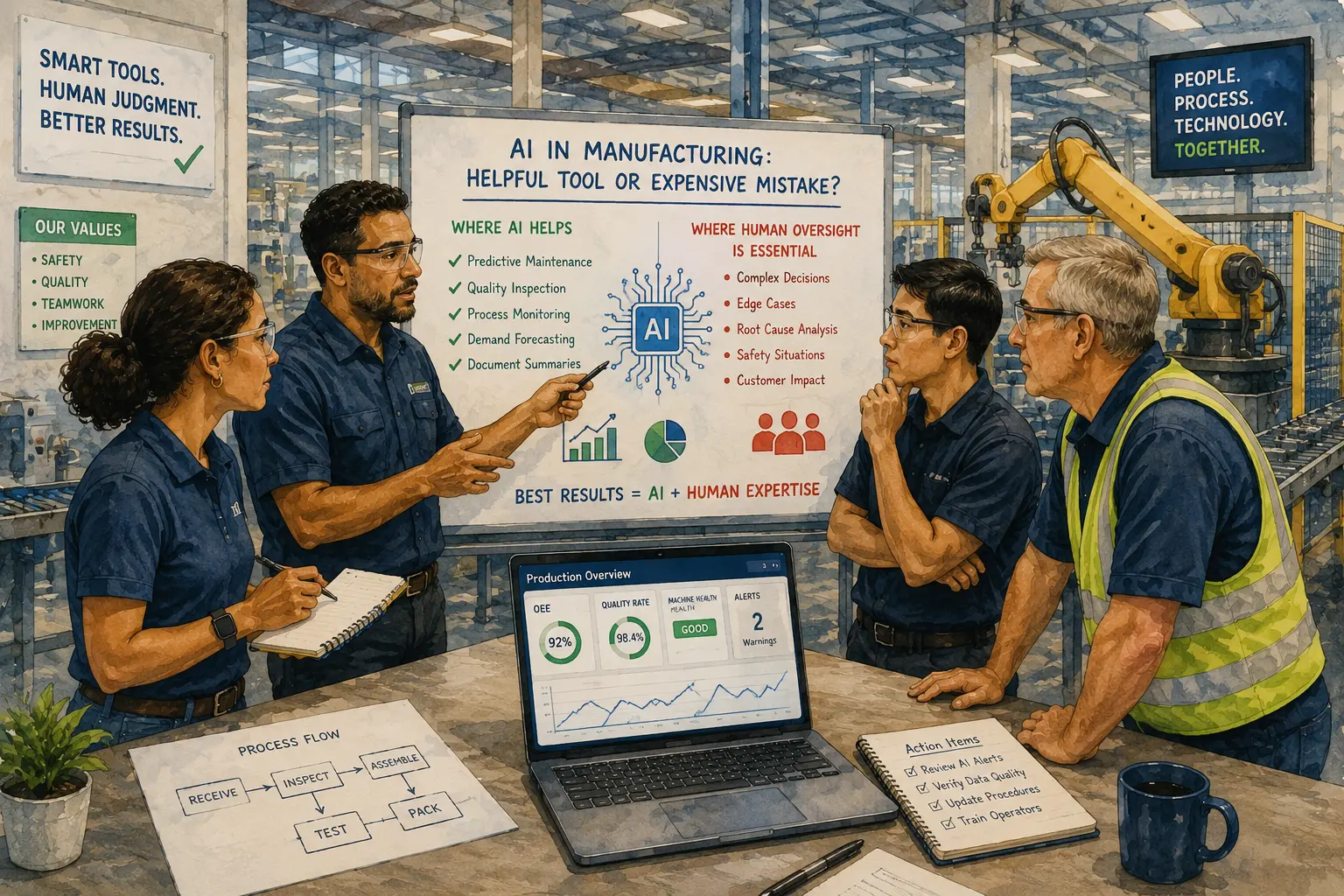
A mid-sized manufacturer wants AI to help onboard new hires. The tool can summarize safety rules, maintenance procedures, and shift handoff notes. That saves time.
But the plant’s senior technician knows which older machine needs extra attention after a humid weekend, which replacement part usually arrives late, and which alarm has a history of false positives. If the company retires that person’s role without capturing the reasoning, the AI system may give technically correct guidance that still misses the real risk.
How to Preserve Experience Before It Leaves
The goal is not to freeze a company in the past. The goal is to separate useful experience from undocumented habit. AI can help with that, but only after people explain what matters.
Practical Steps for U.S. Teams
- Pick one role where turnover, retirement, or automation would create confusion.
- Ask experienced workers to list the top 10 exceptions that are not obvious in the written procedure.
- Record decision points, not just steps. Ask, “How do you know what to do next?”
- Turn the answers into a simple process map, checklist, or knowledge base article.
- Use AI to summarize and organize the material, then have the expert review it.
- Recheck the AI outputs after 30 days and update the source material.
Quick Decision Guide
- If the work is routine and low-risk, AI can handle first drafts, search, and summaries.
- If the work includes judgment under pressure, keep an experienced reviewer in the loop.
- If the expert says, “It depends,” document what it depends on.
- Skip automation if leadership cannot name who owns accuracy after AI is introduced.
Mistakes That Turn AI Into a Management Problem
AI projects fail quietly when companies treat experience as clutter. The problem is not always the tool. Sometimes the company never gave the tool the right knowledge, never assigned a reviewer, or never asked experienced workers what new hires always miss.
Common Mistakes
- Confusing documents with knowledge: A policy explains the official rule. Experience explains the pattern of real exceptions.
- Using AI after layoffs as a cleanup tool: That often means the best source of context is already gone.
- Letting AI invent certainty: A confident answer can still be incomplete, outdated, or wrong.
- Leaving ownership vague: Someone must be accountable for the source material and the final decision.
The 4 Types of Knowledge AI Handles Differently
| Knowledge Type | AI Handles It Well? | Human Role |
|---|---|---|
| Written procedures | Often | Verify that the document is current |
| Historical decisions | Sometimes | Explain why the decision happened |
| Exceptions and edge cases | Limited | Spot what the system misses |
| Judgment under pressure | Weak | Make or approve the final call |
The Bottom Line for U.S. Workplaces
AI will change how companies train, search, and document work. That does not make experienced workers less important. It makes their knowledge more urgent to capture before it disappears.
The best companies will not ask, “Which workers can AI replace?” first. They will ask, “Which human knowledge should AI help us preserve, share, and review?”
What to Do This Month
Choose one critical team and run a small knowledge audit. Do not start with software. Start with the person everyone calls when something goes sideways.
Quick Checklist
- List the roles where one person holds too much process knowledge.
- Ask experts for the exceptions, not only the official steps.
- Convert repeated judgment calls into decision notes.
- Assign a human owner for every AI-supported workflow.
- Review AI mistakes monthly and update the knowledge base.
FAQs
Q1. What is institutional knowledge in simple terms?
A1. It is the practical memory inside a workplace, including procedures, exceptions, customer history, vendor habits, and the judgment people build through experience.
Q2. Can AI help with knowledge transfer?
A2. Yes. AI can organize interviews, summarize documents, draft training material, and improve internal search. The results still need review by people who understand the work.
Q3. Why do experienced workers still matter if AI can read everything?
A3. AI can read documents, but documents rarely contain every exception, relationship, timing issue, or tradeoff that shapes real decisions.
By: Rex Iriarte
Why trust this: Technology and small business editorial coverage focused on AI adoption, workforce decisions, and practical management risk.
Last updated: 2026-06-25
Disclosure: Independent editorial article. No affiliate or sponsored links are included.
References
- Deloitte Insights, “2026 Manufacturing Industry Outlook,” published November 13, 2025. https://www.deloitte.com/us/en/insights/industry/manufacturing-industrial-products/manufacturing-industry-outlook.html
- NIST, “AI Risk Management Framework,” released January 26, 2023. https://www.nist.gov/itl/ai-risk-management-framework



0 Comments