
The App Wants a Promotion
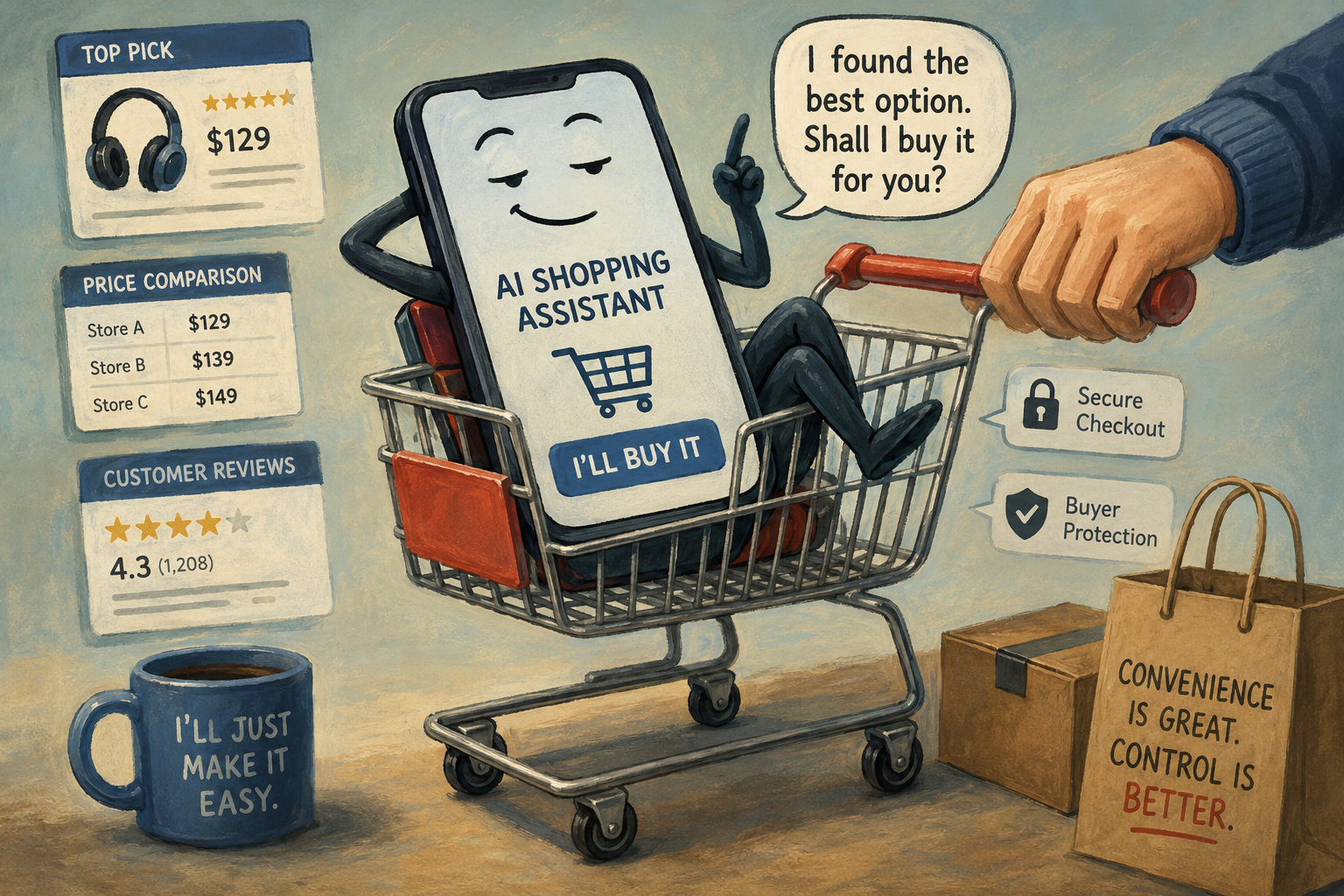
Apps used to help you find things. Now some of them want a promotion: not just search assistant, not just recommendation engine, but shopper. That is where AI Shopping and Agent Commerce start to feel less like convenience and more like an app wearing your jacket.
The promise is simple. Tell the system what you want, let it compare products, maybe let it act for you. The problem is also simple. Buying is not only a search problem. It is a judgment problem, a budget problem, a trust problem, and sometimes a regret problem.
A good AI shopping assistant should reduce friction. A bad one treats friction as an insult. The weird ego appears when the app acts as if the click, the cart, and the final choice are just technical chores it has outgrown.
What This Argument Covers
- The App Wants a Promotion
- The App Does Not Know Your Life
- Agent Commerce Is Delegated Pressure
- The Ego Problem Shows Up at Checkout
- A Better Rule: Assistant First, Buyer Last
- What to Watch Before Letting an App Buy
- Let the Robot Hold the Basket, Not the Wallet
- FAQs
- References
The App Does Not Know Your Life
The pitch behind agent commerce is that shopping is inefficient. Search is messy. Reviews are noisy. Product pages are bloated. Prices move. Return policies are boring. All true.
But the leap from “shopping is annoying” to “let the app shop for you” is a huge jump. A product can match your stated prompt and still be wrong for your home, your habits, your budget, or your tolerance for hassle.
What the Evidence Suggests
The current direction is not science fiction. In 2026, OpenAI described richer shopping discovery inside ChatGPT, powered by the Agentic Commerce Protocol, while also signaling a move toward product discovery and merchant-owned checkout rather than a standalone in-chat checkout experience. In 2025, Amazon said it was testing “Buy for Me,” a feature designed to help customers purchase select products from other brands’ sites when those items were not sold in Amazon’s store.
That tells us something important. The big platforms know the shopping journey is moving upstream. They do not only want to own the checkout button. They want to influence the comparison, the short list, the confidence, and the moment when “maybe” turns into “buy.”
A Dated Example
Imagine a buyer in May 2026 asking an app for “a good office chair under $250 for a small apartment.” A helpful assistant should ask about seat height, return policy, assembly, room size, and whether the buyer needs lumbar support or just a chair that does not look like it came from a cubicle farm.
A pushy assistant skips the human mess. It ranks three chairs, highlights one, and nudges the buyer toward action. That feels efficient, but it may hide the real question: who benefits when the app turns uncertainty into momentum?
Agent Commerce Is Delegated Pressure
Agent commerce sounds calm because “agent” sounds helpful. A travel agent helps. A real estate agent helps. A shopping agent, in theory, helps too.
The pressure comes from the business model around the agent. The same screen that says “I found the best option” may be shaped by catalog access, merchant feeds, paid placement rules, platform priorities, limited inventory, or whatever the system can confidently interpret. Even when the recommendation is useful, it is still a recommendation inside a commercial machine.
Myth vs. Reality
| Claim | More Honest Version | Reader Takeaway |
|---|---|---|
| The app found the best product. | The app found a product it can understand, rank, and present. | Ask what it may have excluded. |
| The assistant knows your preferences. | It knows signals, prompts, past behavior, and available data. | Treat personalization as a clue, not a verdict. |
| Checkout is just a formality. | Checkout is where price, seller, warranty, returns, and payment risk become real. | Slow down before authorization. |
| Less friction is always better. | Some friction protects you from impulse buying and vague terms. | Keep friction where money leaves your account. |
The Small but Important Distinction
There is a difference between “show me the best options” and “buy the best one for me.” The first request keeps the buyer in the decision loop. The second turns judgment into delegation.
That does not make agent commerce bad. It makes it powerful. Powerful systems need boundaries, not just smoother buttons.
The Ego Problem Shows Up at Checkout
The weird ego of an AI shopping app is not that it has feelings. It does not. The ego is in the product design. It shows up when the app behaves as if its recommendation deserves trust by default.
That can happen through language, layout, and timing. A card that says “best choice” feels different from a list that explains tradeoffs. A one-tap purchase prompt feels different from a checkout page that asks you to review seller identity, shipping date, return policy, and total cost.
Where the Simple Take Fails
- Recommendation is not responsibility: If the chair squeaks, the shoes run narrow, or the blender arrives late, the buyer still has to deal with the seller.
- Personalization is not loyalty: A platform can know your habits while still optimizing for its own marketplace goals.
- Automation is not consent: A saved address and payment method do not mean every future purchase should move faster.
- Confidence is not transparency: A clean answer can still be built from incomplete product data.
What Not to Do
Do not let a shopping assistant compress a high-stakes purchase into a vibe. For a $15 cable, convenience may be worth it. For a $900 appliance, a laptop, a mattress, a medical-adjacent device, or anything with complicated returns, the buyer should stay in charge until the final confirmation.
The line is not “AI or no AI.” The line is “advice or authority.”
A Better Rule: Assistant First, Buyer Last
The best version of AI shopping is boring in the right ways. It gathers options, explains tradeoffs, catches missing details, compares return windows, and flags suspiciously thin product pages. Then it gets out of the way.
The buyer should make the final call because the buyer owns the consequences. That is not old-fashioned. That is accountability.
Quick Reality-Check List
- Ask the assistant to show at least three alternatives, not one “winner.”
- Check whether the seller, return policy, warranty, and delivery timeline are visible before checkout.
- Compare the final price, including shipping, fees, taxes, subscriptions, and add-ons.
- Pause before letting an app use saved payment details.
- Keep receipts, confirmation emails, order numbers, and chat summaries.
- Use extra caution when the product affects health, safety, finances, school, work, or major household spending.
A Practical Decision Rule
Let AI narrow the shelf. Let the human approve the cart.
That one rule keeps the useful part of agent commerce without handing over the part that actually matters. A good app can say, “Here are the tradeoffs.” It should not act offended when you want to read the return policy.
What to Watch Before Letting an App Buy
The most important question is not whether the assistant sounds smart. It is whether the purchase path stays visible.
A trustworthy shopping flow should make it clear who the seller is, where checkout happens, who handles returns, what data is being used, and whether the app is acting as a recommender, a broker, a payment helper, or an actual purchasing agent.
The Three-Second Pause
Before approving an AI-assisted purchase, ask three questions:
- Would I buy this if it appeared in a normal search result?
- Do I understand who is responsible if something goes wrong?
- Is the app helping me decide, or rushing me to finish?
If the answer to the third question is “rushing,” back up. The cart will survive a second look.
The Tradeoff Worth Admitting
Agent commerce will help people. It can reduce comparison fatigue. It can help shoppers who hate digging through specs. It can make routine purchases easier, especially when the buyer has already set clear rules.
The tradeoff is that convenience can become obedience. The more the app handles, the less the buyer notices. That is fine for low-risk repeat purchases. It is not fine when the system turns shopping into a quiet autopilot loop.
Let the Robot Hold the Basket, Not the Wallet
AI shopping will not disappear. The useful version is already obvious: better comparison, cleaner product discovery, fewer fake choices, and faster answers to boring questions.
The bad version is also obvious. It is the app that treats your hesitation like a bug. It wants to be helpful, then decisive, then invisible.
Agent commerce should earn trust by staying explainable. Let it sort the shelf. Let it summarize the tradeoffs. Let it remind you about shipping and returns. But the final “buy” should still feel like yours, not like a button the app was always trying to press.
FAQs
Q1. What is agent commerce?
A1. Agent commerce is a shopping model where software can help discover, compare, recommend, and sometimes help complete purchases on a buyer’s behalf. The safest version keeps the buyer aware of seller identity, price, return terms, and final authorization.
Q2. Is AI shopping always bad for consumers?
A2. No. It can be useful for comparison shopping, product research, and routine purchases. The risk rises when the app hides tradeoffs, makes the decision feel automatic, or pushes checkout before the buyer understands the terms.
Q3. Should shoppers let an app buy products automatically?
A3. For low-cost repeat items, limited automation may be reasonable if the buyer sets clear rules. For expensive, personal, regulated, hard-to-return, or unfamiliar purchases, the buyer should review the final cart manually.
Q4. What is the biggest warning sign in AI shopping?
A4. The biggest warning sign is a purchase flow that makes the recommendation easy to accept but hard to question. A trustworthy assistant should make comparison, seller details, and return terms easier to see, not harder.
By: Rex Iriarte
Why trust this: Business and technology commentary based on public product announcements, merchant guidance, and consumer shopping guidance available as of the update date.
Last updated: 2026-05-15
Disclosure: No paid placement influenced this post.
Disclaimer
This commentary is general editorial information, not personal financial, legal, or purchasing advice. Review seller terms, privacy practices, shipping details, return policies, and payment protections before approving a purchase.
References
- OpenAI, “Powering Product Discovery in ChatGPT,” 2026: https://openai.com/index/powering-product-discovery-in-chatgpt/
- Amazon, “Buy for Me button on Amazon Shopping app,” 2025: https://www.aboutamazon.com/news/retail/amazon-shopping-app-buy-for-me-brands
- Federal Trade Commission, “Online Shopping,” consumer guidance: https://consumer.ftc.gov/articles/online-shopping




0 Comments