
AI Bug Hunters Are Making Browser Security Weird
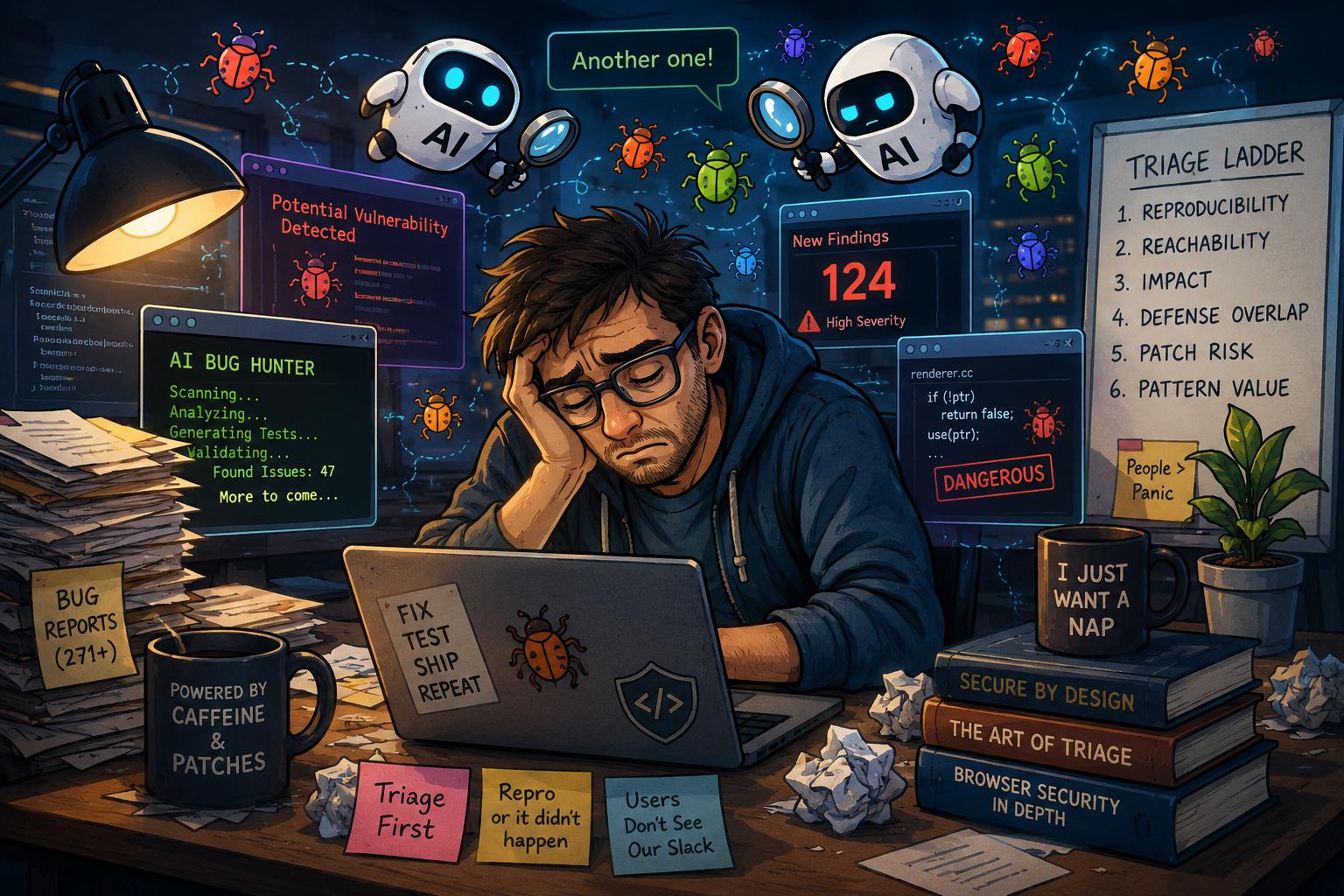
The funny version is easy: AI bug hunters are finding so many browser bugs that developers may need a nap. The serious version is harder. If these systems keep improving, browser security teams will not just need sharper tools. They will need a different rhythm for triage, patching, and deciding what deserves immediate attention.
This is not about replacing security engineers with a magic bot. The better framing is that AI bug hunters can turn hidden defects into visible work. That sounds like a win, and it is, but visible work still has to be verified, prioritized, fixed, reviewed, tested, shipped, and explained to users.
Roadmap for This Take
- AI Bug Hunters Are Making Browser Security Weird
- The Browser Bug Hunt Is Getting Crowded
- Why Browsers Feel the Shock First
- The Real Bottleneck Is Triage, Not Discovery
- A Practical Playbook Before the Bug Queue Explodes
- The Bottom Line: Better Bugs, Tired Teams
- FAQ: AI Bug Hunters and Browser Security
- References
The Browser Bug Hunt Is Getting Crowded
For years, browser security had a familiar cast: internal security teams, outside researchers, fuzzers, red teams, bug bounty hunters, and the occasional vendor emergency. AI bug hunters add a new character to the room, one that can read code, form hypotheses, generate test cases, and repeat the process without needing coffee.
Google’s Big Sleep project made the shift feel real when it reported a previously unknown exploitable memory-safety issue in SQLite in 2024. The headline was not just “AI found a bug.” The more important detail was that the issue was reported and fixed before it landed in an official release, which meant regular SQLite users were not affected.
Mozilla’s recent Firefox work pushed the conversation further. In April 2026, Mozilla said Firefox 150 included fixes for 271 vulnerabilities identified during an initial Claude Mythos Preview evaluation. That is the kind of number that turns “interesting research” into “we need a meeting before lunch.”
The point is not that every AI finding is automatically urgent. The point is that the discovery layer is changing faster than the human repair layer. When discovery gets cheaper, the backlog becomes the battlefield.
Mini Contrast: Hype vs Reality
| Claim | What It Gets Right | What It Misses |
|---|---|---|
| “AI will find every bug.” | AI-assisted research can surface flaws that humans may not have time to hunt manually. | Findings still need reproduction, severity review, deduplication, patch design, and safe release timing. |
| “Developers can ignore AI reports because they are noisy.” | Low-quality automated reports have wasted maintainer time. | The better systems are moving from plausible guesses toward reproducible evidence. |
| “Browser security is solved now.” | More defect discovery helps defenders. | Browsers still depend on layered defenses, careful architecture, release discipline, and human review. |
Why Browsers Feel the Shock First
Browsers are a brutal test case because they sit between the user and nearly everything else online. They parse untrusted content all day, run complex JavaScript engines, handle images, video, fonts, extensions, permissions, sync, accounts, sandboxes, and operating system interfaces. That is a lot of surface area.
A browser bug also rarely lives alone. The scary cases usually involve chains, such as a renderer bug plus a sandbox escape plus a permissions weakness. That is why “one more bug” may be a nuisance, or it may be a doorway into a bigger problem.
AI bug hunters are interesting because they can help inspect the boring, old, awkward parts of a codebase that humans tend to visit only when something breaks. A 20-year-old corner of parsing logic is not glamorous. It may still matter.
The tradeoff is that browsers cannot freeze feature work every time a new batch of findings arrives. If a team receives hundreds of credible reports, the question becomes: which fixes reduce real user risk fastest, which ones can wait for normal release trains, and which ones point to architectural changes that remove a whole class of problems?
The Real Bottleneck Is Triage, Not Discovery
The security industry loves discovery because discovery feels clean. A bug is found. A dashboard lights up. A vulnerability gets a number. Everyone claps.
Actual defense is messier. A team has to answer questions that do not fit neatly into a demo video. Is this exploitable in stable builds? Does it require unusual settings? Is the bug already blocked by sandboxing? Does a small patch create regression risk? Should the team fix one bug, or make a deeper change that prevents similar bugs?
This is where the “developers need a nap” joke stops being just a joke. The emotional load of security work is real. Engineers can accept that hidden defects exist, but it is different when a tool suddenly makes hundreds of them visible and makes delay feel irresponsible.
A Practical Triage Ladder
Use this type of ladder before treating every AI-discovered bug as equal:
- Reproducibility: Can the finding be reproduced with a clear test case?
- Reachability: Can normal web content or a realistic browser feature path reach it?
- Impact: Could it affect memory safety, sandbox boundaries, permissions, privacy, or account security?
- Defense overlap: Is it blocked by an existing mitigation, or does it bypass one?
- Patch risk: Is the fix isolated, or could it break high-traffic browser behavior?
- Pattern value: Does the bug reveal a class of related issues worth fixing together?
This ladder does not make the work easy. It keeps the work from becoming panic-shaped.
A Practical Playbook Before the Bug Queue Explodes
Smaller browser projects, extension developers, app teams, and open-source maintainers should not wait for a giant AI-generated bug pile to arrive. They can prepare now without pretending they have Mozilla or Google-scale security teams.
First, define what a useful report must include. A credible report should include affected versions, a reproducible test case, expected vs actual behavior, crash or log evidence when available, and a plain-language impact summary. Vague claims such as “this code looks unsafe” should go into a lower-priority queue.
Second, separate bug intake from bug fixing. The same engineer should not have to validate every report, debate severity, patch the code, and write release notes in one exhausted loop. Even a tiny team can create roles for intake, confirmation, patch ownership, and final release review.
Third, look for patterns instead of chasing only individual defects. If ten reports involve the same parser, permission boundary, or legacy component, the better fix may be a deeper design change.
Fourth, be honest with users. “We fixed many latent security bugs found through improved analysis” is better than pretending the software suddenly became unsafe overnight. The bugs existed before. The visibility changed.
A 30-Minute Readiness Checklist
- Create one public or internal security-report template.
- Decide which builds are eligible for urgent triage.
- Write a severity guide that separates crash bugs from user-impacting security bugs.
- Prepare a deduplication workflow so repeated AI reports do not flood the same issue.
- Keep a private security queue for sensitive reports.
- Add regression tests as fixes land, not weeks later.
- Track whether repeated findings point to one risky subsystem.
The Bottom Line: Better Bugs, Tired Teams
AI bug hunters are not the end of browser security work. They are the beginning of a more intense maintenance era. The winners will not be the teams that receive the most findings. The winners will be the teams that turn findings into shipped fixes without burning out the humans who understand the code.
The best future is not a browser team asleep under a mountain of alerts. It is a browser team with better intake, better reproducibility, better patch discipline, and fewer old defects hiding in dusty corners.
So yes, developers may need a nap. They may also need a triage clerk, a cleaner bug template, a stronger release checklist, and management that understands one uncomfortable truth: finding the bug is no longer the expensive part.
Fixing it responsibly is.
FAQ: AI Bug Hunters and Browser Security
Q1. Are AI bug hunters replacing human security researchers?
A1. Not in any responsible security program. They can speed up discovery and generate useful leads, but humans still need to validate impact, design patches, review regressions, and make release decisions.
Q2. Does more AI-discovered browser bugs mean browsers are getting worse?
A2. Not automatically. A sudden increase in reported bugs can mean the inspection tools improved. The better question is whether teams can verify and patch the findings before attackers can use similar techniques.
Q3. Should normal users worry about AI bug hunters?
A3. Users should keep browsers updated and avoid delaying security patches. The defensive upside is strong when vendors receive reproducible findings early and ship fixes quickly.
Q4. What should developers do first if AI-generated reports start arriving?
A4. Require reproducible evidence, separate triage from patch ownership, deduplicate aggressively, and look for repeated patterns that suggest a deeper design issue.
By: Marcus Irizarry
Why trust this: Written from a software and IT editorial angle, using public security research, browser-team posts, and vulnerability reward documentation as source context.
Last updated: 2026-05-15
Disclosure: No paid placement influenced this post.
Disclaimer
This article discusses browser security and vulnerability research from a defensive, educational perspective. It does not provide exploit instructions, attack steps, or guidance for breaking into systems.
References
- Google Project Zero, “From Naptime to Big Sleep: Using Large Language Models To Catch Vulnerabilities In Real-World Code” (2024): https://projectzero.google/2024/10/from-naptime-to-big-sleep.html
- Mozilla Blog, “The zero-days are numbered” (2026): https://blog.mozilla.org/en/privacy-security/ai-security-zero-day-vulnerabilities/
- Mozilla Hacks, “Behind the Scenes Hardening Firefox with Claude Mythos Preview” (2026): https://hacks.mozilla.org/2026/05/behind-the-scenes-hardening-firefox/
- Chromium Docs, “Chrome Vulnerability Reward Program News and FAQ” (2026): https://chromium.googlesource.com/chromium/src/+/HEAD/docs/security/vrp-faq.md




0 Comments