
Search Is No Longer Just a Results Page
Search used to feel like a ranked hallway. You typed a question, scanned the blue links, ignored the obvious ads, and decided which door to open. That was never perfectly neutral, but at least the bargain was easy to understand.
Now the page feels like it is making side deals before you arrive. Search rankings sit beside AI summaries, shopping modules, sponsored results, map packs, source citations, video suggestions, and answer boxes. Discovery feels less like finding the best page and more like watching a platform negotiate between your intent, its revenue, and what it thinks you might do next.
That is the real reason this shift feels strange. The web is still there. The path to it is less direct.
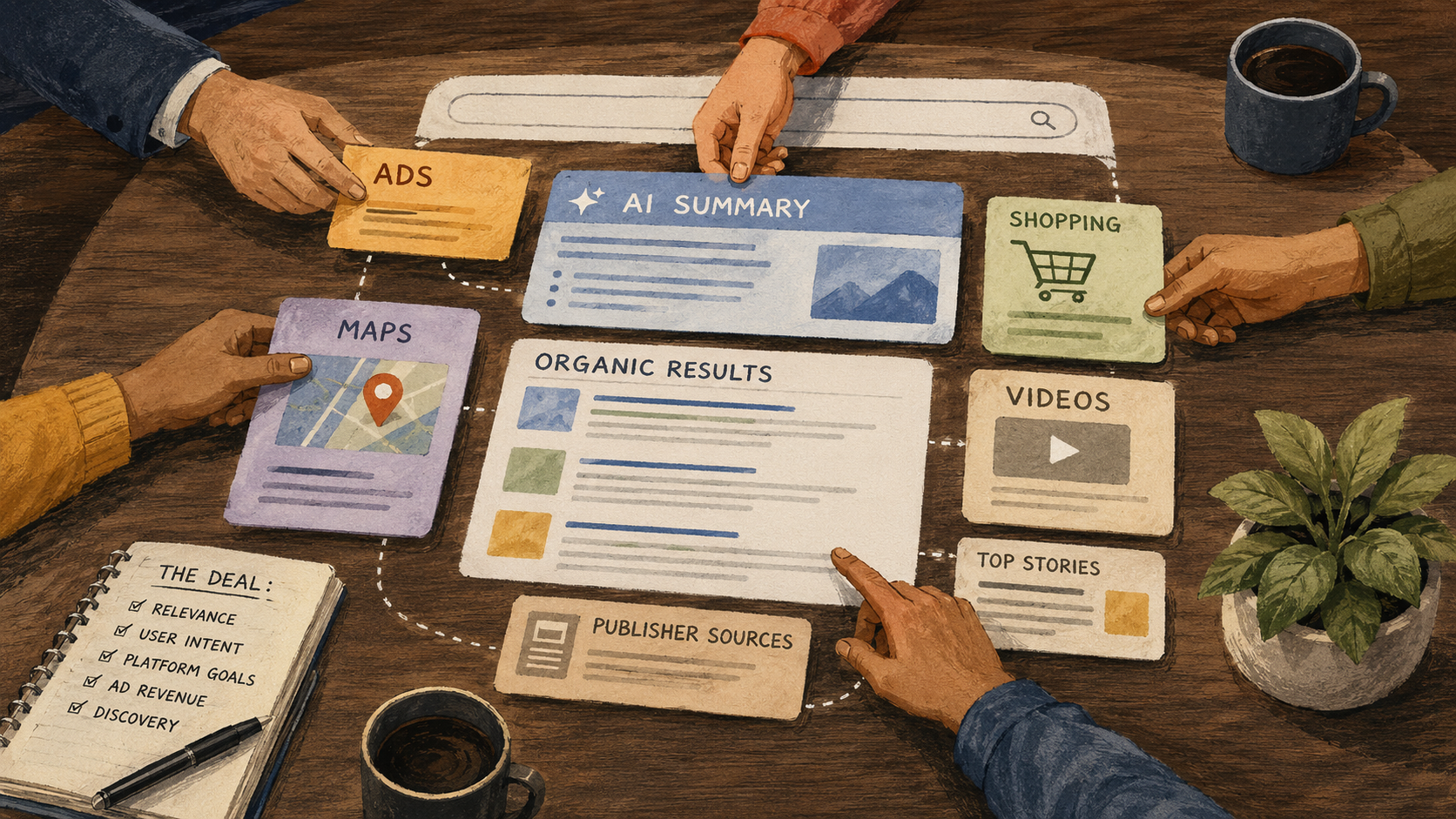
Search Map for a More Complicated Results Page
- Search Is No Longer Just a Results Page
- The Results Page Is a Deal Table Now
- Why Discovery Feels Less Organic
- The Part People Overstate
- What Creators and Readers Should Do Next
- The Reader Still Has Leverage
- FAQ: Search, Rankings, and Discovery
- References
The Results Page Is a Deal Table Now
The old search bargain was simple enough for regular users to understand. A search engine ranked pages, advertisers bought labeled placements, and publishers tried to earn visibility by being useful, relevant, and technically accessible.
That bargain still exists, but it now has more parties at the table. AI summaries can answer the query before a reader clicks. Ads can appear around or inside AI Overviews when Google detects commercial intent. Search campaigns are also moving further into automated matching, where the advertiser supplies inputs and the system finds more query opportunities.
None of that means every result is secretly bought. It means the visible list is no longer the whole product. The page is an interface where organic relevance, machine-generated summaries, ad auctions, user behavior, and platform design all collide.
The old bargain was ranking
For years, ranking was the mental model. First position mattered because it captured attention, trust, and clicks. Even when the page had ads, snippets, maps, and videos, users could still treat the organic results as the main event.
That model trained publishers to obsess over position. It also trained readers to trust the shape of the page. Top meant likely useful. Sponsored meant paid. A snippet meant preview. A link meant the next step.
The trouble is that AI search bends those labels. The first useful answer may be a summary. The first commercial action may be an ad. The first visible source may not be the first organic result. The page is not only ranking pages anymore, it is assembling an experience.
The new bargain is interpretation
Google says AI Overviews and AI Mode can use a query fan-out technique, which issues multiple related searches across subtopics and data sources before producing a response. That matters because it changes what a search is. The user asks one thing, while the system may investigate several adjacent things.
That can be helpful. A vague question like “best laptop for school and light gaming under $800” probably needs comparison, constraints, and tradeoffs. A classic list of pages can work, but an interpreted answer can feel faster.
The uncomfortable part is control. When the platform interprets the query, chooses the sources, summarizes the answer, and places ads near the moment of decision, the reader sees the result of several hidden steps. That is why the page feels like it has been negotiating behind your back.
Why Discovery Feels Less Organic
Discovery feels less organic because clicks are no longer the guaranteed reward for being useful. A publisher can be cited, summarized, outranked by a forum thread, boxed under an ad, or absorbed into a zero-click answer.
Pew Research Center found that, in a March 2025 analysis of U.S. Google searches, users who encountered an AI summary clicked a traditional search result in 8% of visits. Users who did not encounter an AI summary clicked a traditional result in 15% of visits. Pew also found that links inside the AI summaries themselves were clicked in only 1% of visits with such a summary.
That does not prove every missing click was stolen by AI. It does show why the economic mood changed. If a summary satisfies the reader before the click, the publisher may still help create the answer without receiving the visit.
The click used to be the reward
A search click was never just traffic. It was proof of usefulness, a chance to build trust, and a way for independent sites to earn subscribers, sales, ad revenue, or repeat readers.
That reward system is getting thinner. A useful article might now serve three roles at once: training signal, cited source, and unpaid background context. The reader may benefit. The platform may benefit. The publisher may get a brand impression instead of a visit.
For a big brand, a brand impression may be enough. For a small site, a local expert, or a niche blogger, that can feel like being invited to cook and then told exposure is dinner.
Ads have moved closer to intent
The ad side is changing too. Google’s help documentation says ads are eligible to appear above, below, or within AI Overviews, and that ads inside AI Overviews can consider both the user query and the content of the AI Overview. In plain English, the ad is not just chasing a keyword. It is chasing the interpreted situation.
That makes the page feel more negotiated because the commercial layer is no longer sitting apart from the informational layer. It can meet the reader at the exact point where the summary has framed the problem.
Here is a simple example. A reader searches, “why is my home Wi-Fi slow in one room?” The answer may summarize router placement, interference, mesh systems, and internet plan limits. A product ad for a mesh router could appear near that advice. The reader did not search for a product first, but the system turned a troubleshooting question into a buying moment.
The Part People Overstate
The lazy hot take is that search is dead. It is not. Search is becoming less like a library shelf and more like a broker.
That distinction matters. Libraries arrange access. Brokers shape deals. Modern search shapes what counts as an answer, which source gets visibility, which ad gets a chance, and whether a click still feels necessary.
Where the simple take fails
- “AI killed SEO”: Not exactly. Technical access, helpful content, internal links, original information, and clear pages still matter. The difference is that visibility may happen inside an AI surface, not only through a traditional listing.
- “The top result is always the best answer”: That was never guaranteed, and it is even less safe now. The best answer may be buried, summarized, sponsored around, or split across several sources.
- “More content fixes the problem”: Volume can make the problem worse. Thin pages give systems more filler to summarize and readers fewer reasons to click.
- “Only big publishers lose”: Big publishers have leverage, but small creators can lose faster because they depend on fewer winning pages and narrower discovery channels.
The real tradeoff
Readers want speed. Publishers need visits. Platforms want satisfaction, ad revenue, and loyalty. Advertisers want the shortest path to conversion.
Those goals sometimes align. A fast summary can help someone avoid clicking five bad pages. A relevant ad can solve a real need. A niche site can gain visibility if its page becomes a cited source for a complex query.
But the tradeoff is real. Faster answers can weaken the open web if the sources behind those answers lose the traffic that funds them. That is why publisher groups in Europe have challenged AI Overviews, arguing that summaries use publisher content without a realistic way to avoid harm. Google disputes that framing and argues its AI features surface content and help users discover the web. Both sides are revealing the same tension: discovery is now part product, part market, and part policy fight.
What Creators and Readers Should Do Next
Creators should stop treating ranking as the only score. The better question is whether a piece of content gives the search system, the reader, and the site owner a reason to continue the journey.
That means publishing things summaries cannot fully replace. Use firsthand data when you have it, local context, original screenshots, pricing examples, checklists, comparison tables, mistakes to avoid, and decision rules. A generic definition is easy to compress. A useful field guide is harder to flatten.
Readers also need new habits. Do not treat a polished answer box as the end of research when the topic affects money, health, safety, or a major purchase. Look for the source, check whether the source has a reason to know, and compare at least one result outside the summary when the stakes are higher than curiosity.
Quick reality-check list
- Ask whether the result is answering your question or steering you toward a transaction.
- Check whether the visible source is original, expert, local, or just conveniently summarized.
- Compare the AI summary against at least one traditional result for important decisions.
- Notice sponsored labels, shopping blocks, and product modules before clicking.
- For creators, build pages that help readers choose, not pages that merely define a term.
A practical creator test
Before publishing, ask one blunt question: “Would a one-paragraph AI summary make this page unnecessary?”
If the answer is yes, strengthen the page. Add a real scenario. Explain when the advice does not apply. Show a comparison. Include a short checklist. Name the tradeoff. Give the reader a reason to trust the full page, not just the extracted sentence.
This is not about gaming the machine. It is about making work that survives compression.
The Reader Still Has Leverage
Search feels like it is negotiating behind your back because it is negotiating more things at once: relevance, summary quality, source selection, ad auctions, user intent, and platform retention. The page is less neutral than it looks, and more complicated than the old “rank number one” mindset can explain.
The answer is not panic. The answer is sharper reading and better publishing. Readers should check the path, not just the answer. Creators should build pages with judgment, examples, and usefulness that cannot be reduced to a bland summary.
The open web is not gone. But it needs more people who notice when discovery turns into a deal.
FAQ: Search, Rankings, and Discovery
Q1. Does this mean SEO is dead?
A1. No. SEO is changing from a pure ranking game into a visibility and trust game. Technical access, clear structure, useful content, and original value still matter, but a page may now compete for citations, summaries, and follow-up clicks, not only classic organic position.
Q2. Are AI summaries always bad for users?
A2. No. They can help with quick orientation, especially for complex questions. The risk is that users may stop before checking sources, context, limitations, or competing views.
Q3. What should a small publisher focus on now?
A3. Focus on content that has a reason to exist beyond a short answer. Local detail, original examples, clear comparisons, and honest tradeoffs give readers more reason to click, save, share, and return.
By: Rex Iriarte
Why trust this: Editorial commentary grounded in search documentation, platform updates, publisher reporting, and practical marketing analysis.
Last updated: 2026-05-15
Disclosure: No paid placement influenced this post.
References
- Google Search Central, “AI features and your website”: https://developers.google.com/search/docs/appearance/ai-features
- Google Ads Help, “About ads and AI Overviews”: https://support.google.com/google-ads/answer/16297775
- Pew Research Center, “Google users are less likely to click on links when an AI summary appears in the results”: https://www.pewresearch.org/short-reads/2025/07/22/google-users-are-less-likely-to-click-on-links-when-an-ai-summary-appears-in-the-results/
- Reuters, “Google hit by European publishers' complaint to EU over AI Overviews”: https://www.reuters.com/world/european-publishers-council-files-eu-antitrust-complaint-about-googles-ai-2026-02-10/
- Google Ads & Commerce Blog, “We’re upgrading Dynamic Search Ads to AI Max”: https://blog.google/products/ads-commerce/dsa-upgrade-to-ai-max-2026/




0 Comments