
The word “unlocked” is not enough anymore
A phone can be unlocked and still be a bad buy. That is the trap behind many cheap used-phone listings, especially older Android phones that advertise quad-band GSM, dual SIM, and a long list of languages.
Unlocked phone compatibility depends on more than whether a SIM card fits. In the United States, the safer question is practical: will this exact phone work for calls, texts, data, emergency use, and verification codes on the network you plan to use?
Your unlocked phone compatibility map
- The word “unlocked” is not enough anymore
- Compatibility in one minute
- What “unlocked” does and does not prove
- The U.S. buyer check before you pay
- Common mistakes that waste money
- The safer next move
- Unlocked phone compatibility FAQs
- Disclaimer
- References
Compatibility in one minute
- Best for: Anyone buying a used, cheap, imported, prepaid, or “factory unlocked” phone in the United States.
- Main takeaway: Unlocked only means the phone is not locked to one carrier account. It does not prove the phone supports the right network, voice calling method, or carrier approval rules.
- Time, cost, or effort: Plan 10 to 20 minutes before buying: check the exact model, IMEI, LTE bands, VoLTE support, return window, and carrier compatibility page.
- Best result to expect: A phone that activates cleanly, makes calls over LTE, receives SMS codes, and does not become a paperweight after a network change.
- When not to use this: Do not depend on a 2G-only, 3G-only, Android 4.x-era, or no-VoLTE phone as your main device or emergency backup.
What “unlocked” does and does not prove
An unlocked phone is not automatically universal. It usually means the phone is free from one carrier’s SIM lock, so it may accept another SIM card. That is only the first gate. The phone still has to match the network.
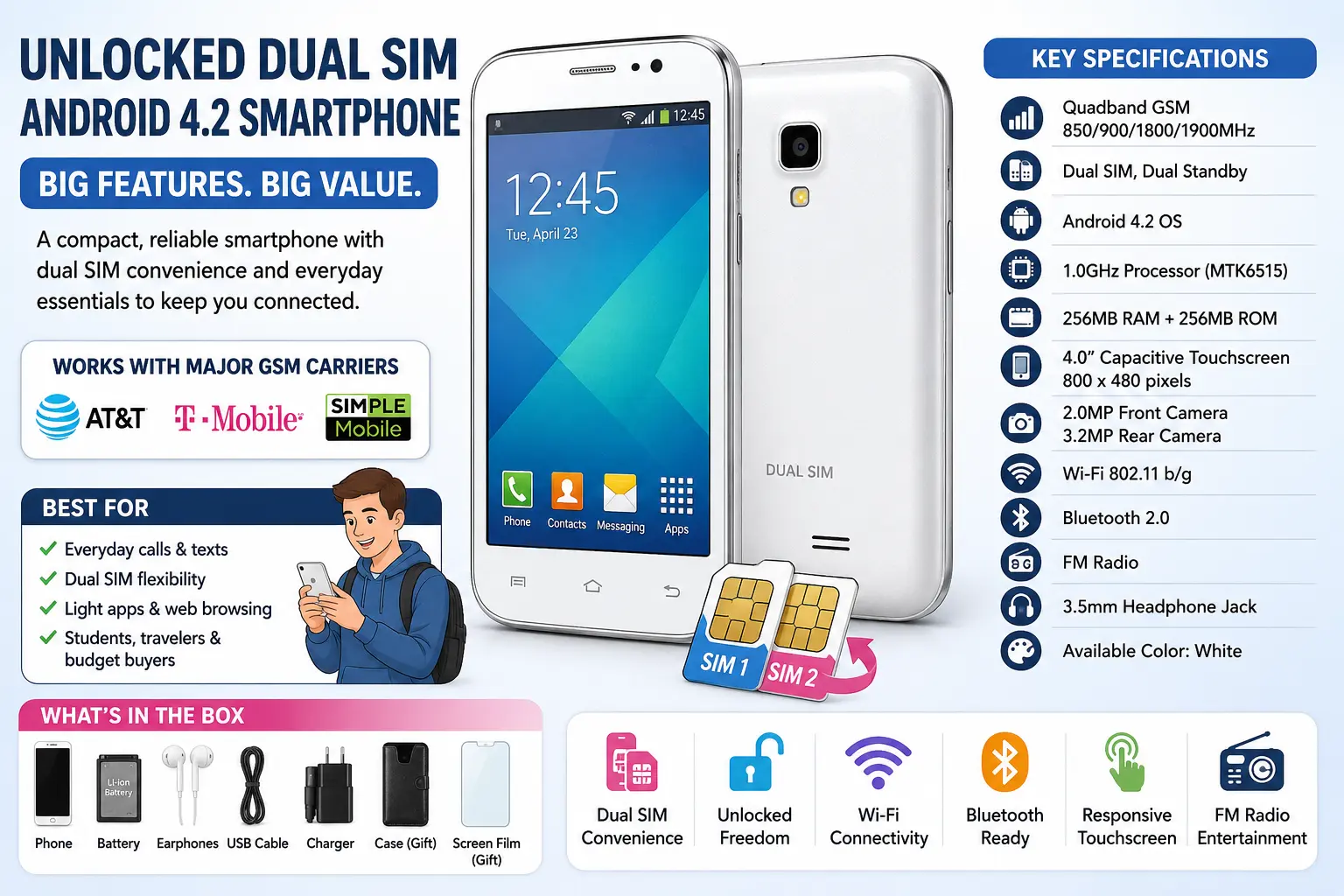
Older listings often highlight specs like GSM 850/900/1800/1900 MHz, dual SIM, Bluetooth, Wi-Fi, Android 4.2, or a 4-inch touch screen. Those details may describe the hardware, but they do not answer the modern compatibility question. Today, the useful checks are LTE band support, VoLTE support, IMEI acceptance, software support, and whether the carrier will activate that device.
The FCC says unlocked devices do not work on every network because network technologies and frequencies vary. That warning matters in the U.S. used-phone market, where a listing can say “unlocked” while the exact model still lacks the network support needed for AT&T, T-Mobile, Verizon, or a prepaid brand using one of those networks.
Key terms buyers should know
- Unlocked: The phone is not restricted by a carrier SIM lock.
- LTE: The 4G network technology many phones still use for data and calling.
- VoLTE: Voice over LTE, which lets calls use the LTE network instead of older 2G or 3G voice systems.
- IMEI: The phone’s unique device identifier, often used by carriers to check activation eligibility.
- MVNO: A prepaid or budget provider that uses another carrier’s network behind the scenes.
A realistic buying scenario
Picture a $35 “unlocked Android” phone on a marketplace listing. The seller says it works with “GSM carriers” and includes a charger, case, and battery. The specs mention Android 4.2, 256 MB of RAM, and 2G GSM bands.
That phone may power on, connect to Wi-Fi, and accept a SIM card. Still, it is not a smart buy for regular U.S. service. AT&T has phased out 3G, Verizon completed its 3G CDMA retirement at the end of 2022, and T-Mobile lists August 3, 2026 as the retirement date for its 2G GSM network. A phone that depends on old voice networks can lose basic calling even if the listing says “unlocked.”
The U.S. buyer check before you pay
Before buying a used or imported unlocked phone, start with the exact model number. “Samsung Galaxy A-series,” “Moto G,” or “unlocked Android” is not enough. The same phone family can have different regional versions with different network bands.
Next, use the carrier’s own bring-your-own-device checker when available. T-Mobile, for example, asks buyers to confirm that the phone is both unlocked and compatible with its network. The IMEI result is more useful than a seller’s generic claim because it reflects the carrier’s current activation rules.
Practical compatibility steps
- Get the exact model number. Look for the full model, not only the brand or product name.
- Ask for the IMEI before meeting or paying. Use the carrier’s compatibility checker where available.
- Confirm LTE and VoLTE support. A phone that only supports 2G or 3G should be treated as obsolete for normal U.S. service.
- Check the return window. Avoid “final sale” listings unless the price is low enough to accept the loss.
- Test calls, SMS, mobile data, and hotspot if needed. Do this before relying on the device.
Quick decision guide
- If the phone passes the IMEI checker and supports LTE plus VoLTE, it may be worth testing.
- If the seller refuses to provide the exact model or IMEI, skip it.
- If the phone is advertised mainly as 2G, GSM-only, or Android 4.x, treat it as a Wi-Fi gadget, not a dependable phone.
- If the device is for work, two-factor codes, rideshare apps, banking apps, or client calls, buy a newer model with active software support.
Common mistakes that waste money
The biggest mistake is confusing “SIM unlocked” with “network approved.” A phone can accept your SIM and still fail activation, fail voice calling, or lose service after a carrier change.
Another common mistake is buying based on the product title. Old listings often stack terms like “quadband,” “dual SIM,” “factory unlocked,” “AT&T,” “T-Mobile,” “Simple Mobile,” and “newest model.” That wording may have been written for an older network era. In 2026, the better question is whether the phone supports current U.S. LTE or 5G service and whether the carrier will allow it on the network.
Common mistakes
- Trusting the word “unlocked” by itself: It sounds final, but it only answers one part of the compatibility question.
- Ignoring VoLTE: Some older phones can use data but still fail normal voice calling.
- Buying a 2G or 3G phone for emergencies: Old networks have been shut down or are being retired, so emergency reliability is not a safe assumption.
- Skipping the return policy: A cheap phone is not cheap if it cannot be activated and cannot be returned.
Compatibility comparison
| Option | Best for | Pros | Cons |
|---|---|---|---|
| New unlocked phone from a major manufacturer | Main everyday phone | Better odds of LTE, 5G, VoLTE, warranty, and updates | Costs more upfront |
| Recent used phone from the same carrier family | Budget buyer who still needs reliability | Easier activation path and better network match | Must check IMEI, lock status, and battery health |
| Imported unlocked phone | Hobbyist or advanced user | Sometimes cheaper or has unusual features | Higher risk of missing bands, activation blocks, or weak support |
| Old 2G or 3G Android phone | Wi-Fi-only experiment or collector item | Low cost and simple hardware | Not dependable for normal U.S. cellular service |
The safer next move
Use a simple rule: no exact model, no IMEI check, no purchase. That one sentence prevents most compatibility mistakes.
For a personal backup phone, look for a recent LTE or 5G phone that supports VoLTE and passes the carrier checker. For a small business, avoid bargain-bin phones for payment apps, delivery apps, client calls, or two-factor authentication. Saving $40 on hardware can become expensive if the device misses calls or cannot receive verification codes during a busy day.
Quick checklist before buying
- Confirm the exact model number.
- Run the IMEI through the carrier’s compatibility checker.
- Confirm LTE and VoLTE support.
- Avoid 2G-only, 3G-only, and Android 4.x-era phones for active service.
- Test calls, texts, mobile data, and app sign-ins before the return window closes.
- Keep screenshots of the listing, return policy, and seller claims.
The bottom line on unlocked phones
Unlocked phone compatibility is not a yes-or-no label. It is a chain of checks: SIM lock, network technology, LTE or 5G bands, VoLTE, IMEI approval, software support, and return protection.
A used phone can still be a smart buy, but only when the listing survives those checks. If a seller leans on old words like “quadband GSM” or “works with any GSM carrier,” slow down. The modern U.S. network question is not whether the SIM fits. It is whether the carrier will activate the phone and whether the phone can still do the everyday jobs you need.
Unlocked phone compatibility FAQs
Q1. Does unlocked mean a phone works with every U.S. carrier?
A1. No. Unlocked means the phone is not tied to one carrier’s SIM lock. It still needs the right network technology, frequency support, VoLTE capability, and carrier activation approval.
Q2. Can I still use an old 2G or 3G phone on Wi-Fi?
A2. Sometimes, yes. Many old phones can still connect to Wi-Fi, play stored media, or run basic offline tools. That does not make them dependable cellular phones, especially for calls, text codes, maps, or emergency use.
Q3. Is a cheap imported unlocked phone always risky?
A3. Not always, but it needs extra checking. Imported models may miss U.S. bands or fail a carrier’s IMEI checker even when the hardware looks similar to a U.S. model. Check before paying.
Q4. What should small businesses check before using used phones for staff?
A4. Check activation, VoLTE, battery health, update status, app compatibility, and the return policy. For payment apps, delivery apps, business messaging, and two-factor codes, reliability matters more than the lowest price.
By: Marcus Irizarry
Why trust this: Editorial technology guide for IOComputer.net based on official FCC and U.S. carrier compatibility references current as of 2026-06-15.
Last updated: 2026-06-15
Disclosure: No paid placement influenced this post.
Disclaimer
Carrier rules, network availability, and device activation policies can change. Always confirm compatibility with the carrier or prepaid provider before buying, switching, or relying on a phone for work, safety, or emergency communication.
References
- Federal Communications Commission — “Cell Phone Unlocking” — Explains that unlocked phones must still be compatible with a carrier network.
- AT&T — “AT&T is shutting down its 3G network: Here’s how to prepare” — Provides AT&T’s 3G phase-out context.
- T-Mobile — “T-Mobile Network Evolution” — Lists T-Mobile’s 2G GSM retirement date and related customer guidance.
- Verizon Business — “3G CDMA Network Retirement” — Documents Verizon’s 3G CDMA retirement timeline.



0 Comments