
Why One Good AI Answer Can Feel Safer Than It Is
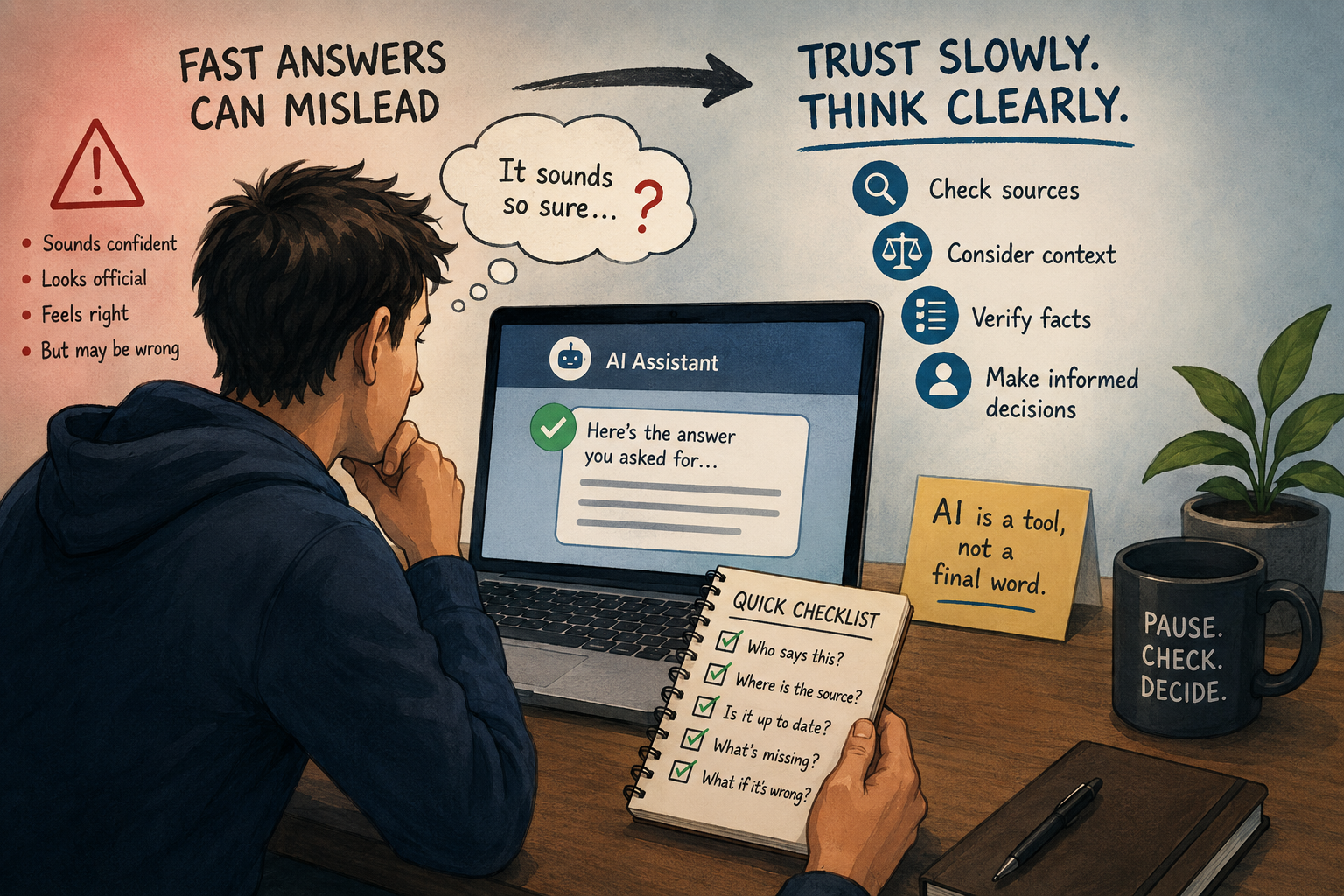
The first answer from an AI tool can feel strangely convincing. It is fast, organized, polite, and usually written with more confidence than a real person would use. That is where AI trust issues often begin.
The concern is not that every AI mistake causes psychological harm. The concern is that a smooth first answer can train a person to skip the small habits that protect judgment: pausing, checking, comparing, and asking whether the tool is even suited for the task. Over time, that pattern can create false confidence, anxiety after mistakes, and a weaker sense of ownership over decisions.
What This Guide Covers
- Why One Good AI Answer Can Feel Safer Than It Is
- The Quick Answer: Trust Slowly, Verify Early
- What First-Try Trust Does to Your Judgment
- The Psychology of Overreliance: Confidence, Offloading, and Embarrassment
- A Practical Trust Test Before Using AI Output
- When Not to Use an AI Tool as Your First Stop
- FAQs
- References
The Quick Answer: Trust Slowly, Verify Early
- Best for: Readers who use AI tools for writing, school, work, research, planning, or decision support.
- What this covers: How trusting an AI tool on the first try can affect judgment, confidence, and emotional stress.
- What this does not cover: Diagnosis, therapy, legal advice, financial advice, or medical advice.
- Main caution: A confident answer is not the same as a reliable answer.
- When to get professional help: If AI use is replacing qualified support for serious emotional distress, health questions, legal matters, financial decisions, or safety concerns.
The safest habit is simple: treat the first answer as a draft, not a verdict. For low-risk tasks, a draft can be useful. For anything that affects money, health, relationships, school consequences, reputation, legal risk, or safety, the first answer should trigger a checking step before action.
What First-Try Trust Does to Your Judgment
AI tools are designed to reduce friction. That is useful when you need a summary, outline, brainstorm, or starting point. The problem appears when reduced friction becomes reduced thinking.
When a tool gives a fluent answer in seconds, the brain gets a reward: less effort, less uncertainty, and a feeling of progress. That can make the answer feel more reliable than it deserves. A person may start thinking, “It sounded right last time, so it is probably right again.”
That is the trap. AI systems can perform well in one task and fail quietly in another. NIST’s AI Risk Management Framework treats trustworthy AI as something that must be measured, managed, and monitored, not assumed because a system sounds confident or worked once.
Three ways first-try trust can mislead you
- Fluency bias: Clean writing makes weak reasoning look stronger.
- Authority transfer: The tool’s polished tone can feel like expertise, even when no expert has checked the answer.
- Memory shortcut: One good result becomes a mental shortcut for future trust.
A first answer can be useful, but it should not become a shortcut around your own judgment.
The Psychology of Overreliance: Confidence, Offloading, and Embarrassment
The psychological risk is usually gradual. It often looks less like one dramatic mistake and more like a habit loop.
First, the tool saves effort. Then the user checks less. Then the user becomes more comfortable accepting answers. Eventually, the user may feel unsure without the tool, even for tasks they could have handled before.
Researchers often discuss this pattern through ideas like automation bias, overreliance, and cognitive offloading. Microsoft Research published a 2025 study on generative AI and critical thinking based on 319 knowledge workers and 936 reported work examples. The study focused on how confidence in AI and confidence in oneself can shape the amount of critical thinking people report using.
That does not mean AI use automatically damages critical thinking. It means the habit of outsourcing judgment deserves attention, especially when the tool is used as the first stop every time.
Mini scenario: the polished answer that backfires
Imagine a student, freelancer, or office worker asks an AI tool to explain a policy, summarize a contract clause, or draft an email about a sensitive issue. The answer looks clean. They copy it with only light edits.
Later, a teacher, client, manager, or colleague points out that the answer misunderstood the policy. The practical problem is the error. The psychological problem is what happens next: embarrassment, second-guessing, frustration, and the feeling of, “I should have known better.”
That feeling can push people in two opposite directions. Some stop using the tool completely. Others use it even more, hoping the next answer will fix the last one. Neither response is ideal. The healthier response is calibrated trust: use the tool, but keep responsibility for the final call.
What not to assume
- “It answered fast, so it must know.” Speed is not evidence of accuracy.
- “It sounds neutral, so it is balanced.” A calm tone can still hide missing context, bias, or outdated information.
- “It got my simple question right, so it can handle a serious one.” Performance does not transfer evenly across topics.
A Practical Trust Test Before Using AI Output
Before relying on an AI answer, run a quick trust test. This does not need to be complicated. The goal is to slow down just enough to prevent blind acceptance.
The 5-minute AI trust check
- Name the risk level. Is this low-risk, medium-risk, or high-risk?
- Ask what would happen if it is wrong. Would the mistake be annoying, expensive, embarrassing, unsafe, or hard to undo?
- Check one independent source. For factual claims, compare the answer with a reputable source outside the tool.
- Look for missing context. Ask whether the answer depends on location, date, policy, age, health status, budget, or legal rules.
- Rewrite the final decision in your own words. If you cannot explain it without the tool’s phrasing, you may not understand it well enough yet.
Trust-level comparison table
| Use case | Safe first move | What to verify | When not to rely on the first answer |
|---|---|---|---|
| Brainstorming blog titles | Use it for options | Tone, originality, keyword fit | When it invents claims or promises results |
| Summarizing a public article | Use it as a rough draft | The original source and dates | When the summary replaces reading important details |
| Writing a sensitive email | Use it for structure | Accuracy, tone, relationship context | When legal, job, school, or family consequences are serious |
| Health or mental wellness questions | Use it only for general education | Qualified medical or mental health sources | When symptoms, medication, crisis, diagnosis, or treatment choices are involved |
| Legal or financial questions | Use it for vocabulary and questions to ask | Current law, official rules, professional advice | When money, contracts, taxes, benefits, debt, or rights are affected |
The table has one pattern: AI can help prepare thinking, but it should not replace accountable judgment in high-stakes situations.
When Not to Use an AI Tool as Your First Stop
There are moments when an AI tool should not be the first place you go. This is especially true when the answer depends on current rules, personal facts, emotional nuance, or professional responsibility.
The FTC has repeatedly warned that AI claims can be exaggerated or deceptive, especially when tools are sold as shortcuts to results. Health-related AI also needs extra caution. The APA and WHO both discuss the importance of consumer safety, governance, and appropriate limits when AI tools are used around mental health or health-related decisions.
Safer next steps
- Use AI for questions, not conclusions. Ask it to list what you should verify, not what you should blindly do.
- Separate drafting from deciding. Let the tool help organize thoughts, then make the decision after checking facts.
- Keep a “human review” rule. For anything high-stakes, involve a qualified person, official source, teacher, supervisor, parent or guardian, licensed professional, or trusted expert.
- Save the source trail. If the answer matters, keep links, dates, screenshots, or notes showing what you checked.
- Notice emotional dependence. If using the tool makes you feel calmer only because it gives instant certainty, pause before acting.
Red flags that trust has gone too far
- You accept the first answer because checking feels annoying.
- You feel unable to start simple tasks without asking the tool first.
- You use the tool to avoid a difficult conversation with a real person.
- You treat the tool’s confidence as proof.
- You feel ashamed after mistakes but keep repeating the same copy-and-paste pattern.
- You use AI output for serious health, legal, financial, school, workplace, or safety decisions without human or official review.
A better rule: trust the process, not the tool
The goal is not to fear AI. The goal is to stop treating convenience as credibility.
A healthier relationship with AI tools looks like this: ask, inspect, verify, adapt, and own the final answer. That process protects both accuracy and confidence. You are not trying to prove the tool useless. You are training yourself to stay mentally present while using it.
Final Thought: Fast Answers Still Need Slow Judgment
The psychological damage of trusting an AI tool on the first try is not usually instant. It is the slow weakening of checking habits, the rise of false confidence, and the stress that follows when a polished answer turns out to be wrong.
AI tools can be helpful when used as assistants, drafts, and idea generators. They become risky when they are treated like final authorities. The best protection is not paranoia. It is a simple habit: let the first answer start the work, not finish it.
FAQs
Q1. Is it bad to trust an AI tool at all?
A1. No. The problem is not trust by itself. The problem is blind trust before checking the risk level, source quality, and possible consequences.
Q2. Can using AI reduce critical thinking?
A2. It can, especially when a person uses it to replace thinking instead of support thinking. The safer habit is to use AI for drafts, questions, outlines, and comparison points, then verify and decide separately.
Q3. What is the safest way to use AI for sensitive topics?
A3. Use it to prepare better questions, summarize general concepts, or organize notes. Do not use the first answer as the final decision for health, legal, financial, safety, school discipline, workplace, or relationship matters.
Q4. How do I know when an AI answer needs checking?
A4. Check it when the answer includes facts, statistics, laws, policies, medical information, money decisions, deadlines, personal accusations, or anything that could harm someone if wrong.
By: Marcus Irizarry
About the author: Technology and web systems contributor covering practical software use, IT service, ecommerce, and digital workflow decisions.
Last updated: 2026-05-14
Disclosure: No affiliate links or sponsorships are included.
Disclaimer
This article is for general educational purposes only. It is not medical, mental health, legal, financial, or safety advice. If an AI tool is being used to make decisions that could affect health, emotional well-being, money, legal rights, school standing, work status, or personal safety, use qualified human support and official sources before acting.
References
- NIST: AI Risk Management Framework
- American Psychological Association: Health advisory on chatbots and wellness apps
- Microsoft Research: The Impact of Generative AI on Critical Thinking
- FTC: Artificial Intelligence guidance and enforcement
- WHO: Ethics and governance of artificial intelligence for health




0 Comments